A Q&A with Princeton’s Owen Zidar on his new book, “The Everwhere Millionaire”
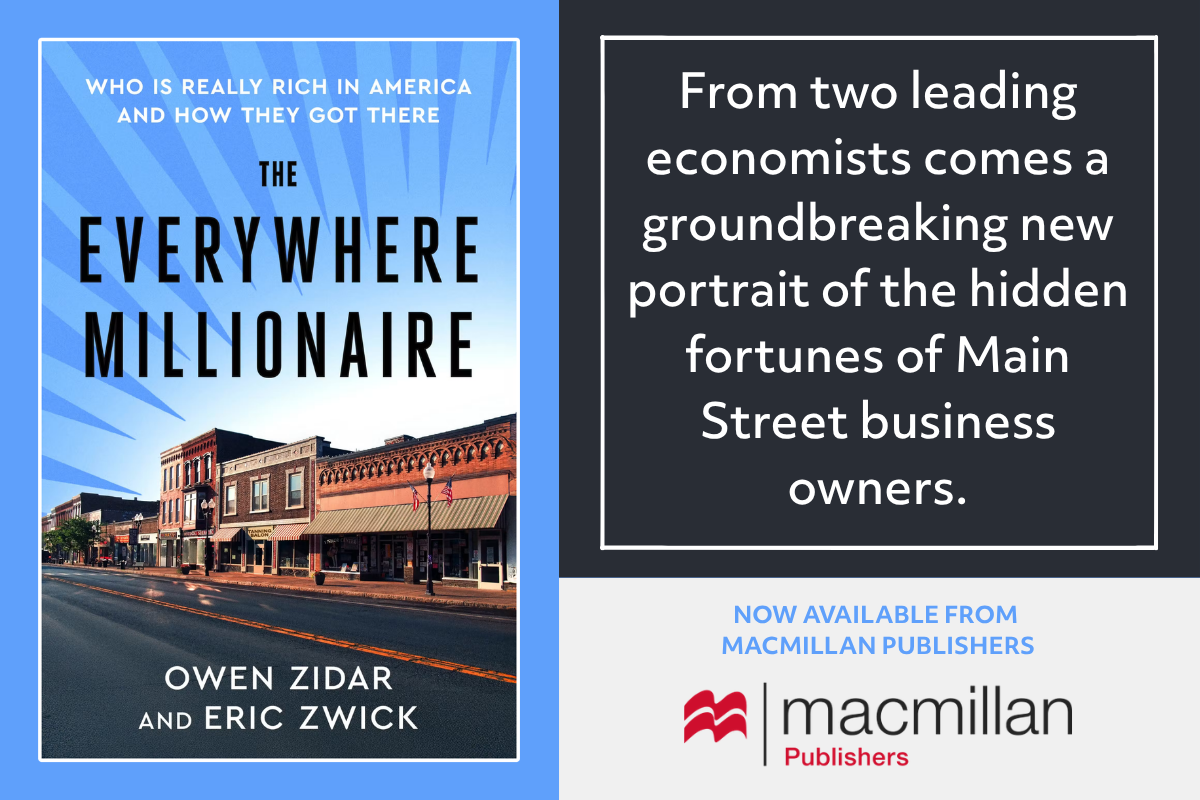
When the average person thinks of great wealth, they might think of tech giants or celebrities, but the truth about who holds the majority of wealth in America is far more interesting. In their soon-to-be-released book, The Everywhere Millionaire, Princeton’s Owen Zidar, Professor of Economics and Public Affairs, and his long-time friend and collaborator Eric Zwick, the Joel F. Gemunder Professor of Economics and Finance at the University of Chicago, uncover the unglamorous reality of America’s often under-the-radar millionaire class.
Part economic detective story, part roadmap to riches, this book reveals who the hidden 1% are (and their stories), a blueprint for building wealth today, and how these everywhere millionaires are using their fortunes to wield both economic and political power.
The Everywhere Millionaire celebrates the stories of entrepreneurs who seized opportunities while asking hard questions about how concentrated wealth and power shape society. It is an essential guide to seeing the economy as it really is and recognizing the surprising paths to prosperity—and influence—everywhere.
Here, Zidar answers a few questions about the research behind The Everywhere Millionaire and the impact he hopes the book will have on readers.
The Everywhere Millionaire is set to release on September 15, 2026. The book is available for pre-order. For further reading, visit Zidar’s Substack and book website.
Q: Where did the research that led to “The Everywhere Millionaire” begin?
Zidar: In 2014 Eric Zwick and I had just finished grad school, and Danny Yagan, who’d finished a couple of years earlier, joined us when the Treasury Department asked us to help with what seemed like a pretty narrow question: how much tax do private business owners actually pay? So we moved to DC, got an apartment together, and went to work in Treasury’s Office of Tax Analysis. Answering it turned out to be hard, because the IRS data sat in separate systems that weren’t set up to be linked. We ended up building the first de-identified database that connects tax records from businesses to their owners and their workers.
In doing so, we discovered a hidden world of ordinary Americans who had gotten extraordinarily rich running private businesses. Over the past decade we’ve written a series of research papers on top incomes, top wealth, and entrepreneurship that are the foundation for this book.
Q: What surprised you most when you began collecting data and stories for the book?
Zidar: Two things. First, how central these business owners are to the whole inequality story. Pass-through businesses account for more than half of the rise in the top 0.1 percent’s share of income since the 1980s. If you want to understand who got rich in America over the last forty years, you have to understand these folks, and hardly anyone was talking about them.
The second was the industries. I expected hedge funds and software. Law and finance are up there, but right behind them are auto dealers, and then consultants, oil and gas, doctors with their own practices, homebuilders, accountants, HVAC contractors, dentists. As we put it in the book, we’d been missing the vast forest of American entrepreneurs for a few redwoods in Silicon Valley.
Q: How does this book reframe the way we look at “the rich” today?
Zidar: Many people think the rich are billionaires in tech and on Wall Street. That group is a small sliver of the really rich. One way to see it is to go to any golf resort, lake, or mountain town in America and ask who owns the big houses.
We do something like that in the book, taking a road trip across the country to meet people and get a sense of who the real rich are and how they got there. We interviewed dozens of people for the book, and it’s fun to combine their stories with data from more than a decade of research. Another way to see it is to ask who the richest person in your town or your high school is. The answer is almost never Elon Musk. More often, it’s somebody who owns a business you drive past every day.
Q: Who do you hope will benefit most from this book?
Zidar: We have two groups in mind. One is people aspiring to be wealthy themselves. We hope the stories and the data show that wealth is more attainable and closer to home than many people may have thought, and that the path usually runs through owning a business rather than earning a salary.
The second is people who want to understand the economy as it really is. We want to celebrate the stories of entrepreneurs who seized opportunities while asking hard questions about how concentrated wealth and power shape society. It’s really striking how important private business owners are to our politics and policy outcomes.