Three students win 2026 Junior Prizes for outstanding performance in challenging economics coursework and research
The Economics Department at Princeton is celebrating three students as recipients of this year’s Junior Prizes: Sofia Arora (1st place), Jerry Zhu (2nd place), and Ivy Chen (3rd place).
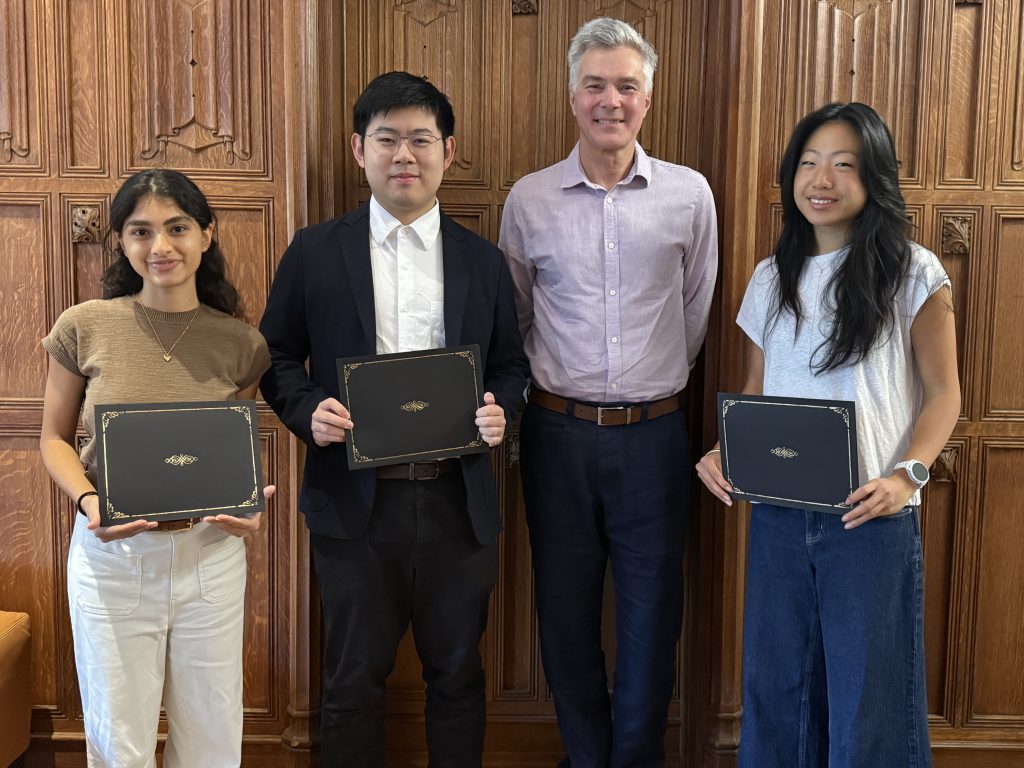
Each year, the Princeton Economics Department awards the prestigious Junior Prizes to select seniors in recognition of their high GPA and outstanding junior independent work (JIW).
1st-place winner Sofia Arora worked around her “data-scarce context”
Sofia Arora’s paper, titled “Forests Under Fire: The Economic Impact of Conflict on Deforestation in the Democratic Republic of the Congo,” studies deforestation in the second-largest tropical rainforest, where weak institutional capacity to protect those forests creates a tinderbox for this vulnerable ecosystem. “I’m broadly interested in environmental economics,” shared Arora. “I was exposed to the literature on deforestation and state capacity the summer before my junior year when I interned at the World Bank. I helped on a project on enforcing deforestation laws in the Brazilian Amazon, and I decided to study deforestation in a different context for my JP.” Arora is pursuing minors in statistics and machine learning as well as optimization and decision science.
While Arora had a rough idea of what she wanted to study, the data was harder to pin down. With help from her adviser, Professor Smita Brunnermeier, Arora got creative, utilizing the data that is available to answer her research question. “The research process was very iterative for me,” said Arora. “I had to collect data from about twelve different sources because the DRC is a data-scarce context–the country has not had a census since 1984. I relied on remote sensing data and modeled estimates of key variables like population density. Once I had the data, I found it difficult to isolate a causal effect of conflict and deforestation because the two variables are linked to overall political instability in particular regions. So, I looked for factors that affect conflict but not deforestation directly, so I could tell whether conflict itself was driving forest loss.”
For Arora, the process of writing her JIW solidified her interest and goals. “I am studying energy economics for my senior thesis, and I hope to continue researching how government policies and political institutions affect environmental protection and energy access in my career.”
Advice for other student researchers
Now in their senior year, this year’s Junior Prize winners shared some advice for students at the beginning of the independent research process.
As a student interested in microeconomic theory, Jerry Zhu, whose junior paper is titled “Welfare in the Stable Marriage Problem under Concave Utility,” chose the topic after being introduced to it in ECO 317: The Economics of Uncertainty and finding matching especially interesting. Professor Nobu Kiyotaki served as Zhu’s adviser for the project.
During his research process, which involved reading a number of papers in the field, sketching out models, and testing various conjectures, Zhu ran into modeling challenges. “It was challenging to come up with a model that was simple enough to illustrate the features I was interested in while still being analytically tractable.” However, with support and advice from several professors, Zhu created a model that worked for his project.
Zhu’s advice for students working on their JIW: talk about your project. “It’s helpful to talk to other people about your research, especially professors, but also friends—my friends were a useful sounding board for thinking about modeling choices.” He added, “It was also a good way to check whether my ideas were easy to present and explain.”
As a student interested in microeconomic theory, Zhu found the project a helpful starting point for future research. “The JIW was a good place for me to start doing research and learn some of the challenges that came with writing a paper from scratch. It was ultimately a fun experience that reinforced my interest in the field.”
Ivy Chen, whose paper is titled “The effect of restricted abortion access on female community college enrollment in the post-Roe era,” looked to the current reproductive rights landscape as it relates to education for her project. “I was curious about whether abortion restrictions might materially impact outcomes for college-aged women.” Chen continued, “Furthermore, I thought that there was a lot of interesting geographic variation, since abortion laws have somewhat fractured along state lines following the 2022 Dobbs decision. Reading through the previous literature suggested that past restrictive abortion environments have indeed negatively affected female educational attainment, and I started thinking about what kinds of students might be more affected by local-level laws, which led me to consider community colleges.” Her adviser, Mica Sviatchi, provided invaluable support during Chen’s research process.
Early in her project, Chen investigated the available datasets and the outcomes they contained. This led her to choose institutional-level data rather than individual-level data, which informed the question she posed in her paper as it related to education. Chen shared, “I definitely encountered challenges regarding revising my model and not finding the results I had initially anticipated; one thing that the process taught me was that null results aren’t necessarily a dead end, and can still inspire other interesting extensions or questions to investigate.”
Chen recommends leaning into the existing literature, and specifically the gaps in research, to inform your project: ask, “What is missing, and what is intriguing about those absences that might merit learning more?” She also advises students, even if they have a good idea of what they want to study, to stay open-minded when exploring the data. Chen adds, “Although the project can sound daunting, there are many resources for support (your adviser, your TA, ESS, data librarian, etc.); choose a topic you feel passionate about, and have fun!”
“I found the research process super rewarding,” shared Chen, “and it was especially fulfilling to investigate a question I was passionate about and believed to be meaningful. Working on my JP deepened my interest in labor economics and economic research with relevant policy implications; I am now excited to explore something new with my senior thesis!”
These sentiments are echoed by first-place winner Arora, who also recommends starting empirical papers early, since data collection can often take longer than expected. “Choose a topic that you’re interested in reading and talking about! The data may surprise you, so be ready to try new approaches to your research question.“
For more advice, information, or resources on Junior Papers, visit the Junior Independent Work (JIW) page on the Economics Department website.