Ellora Derenoncourt Joins Symposium on Wealth Inequality
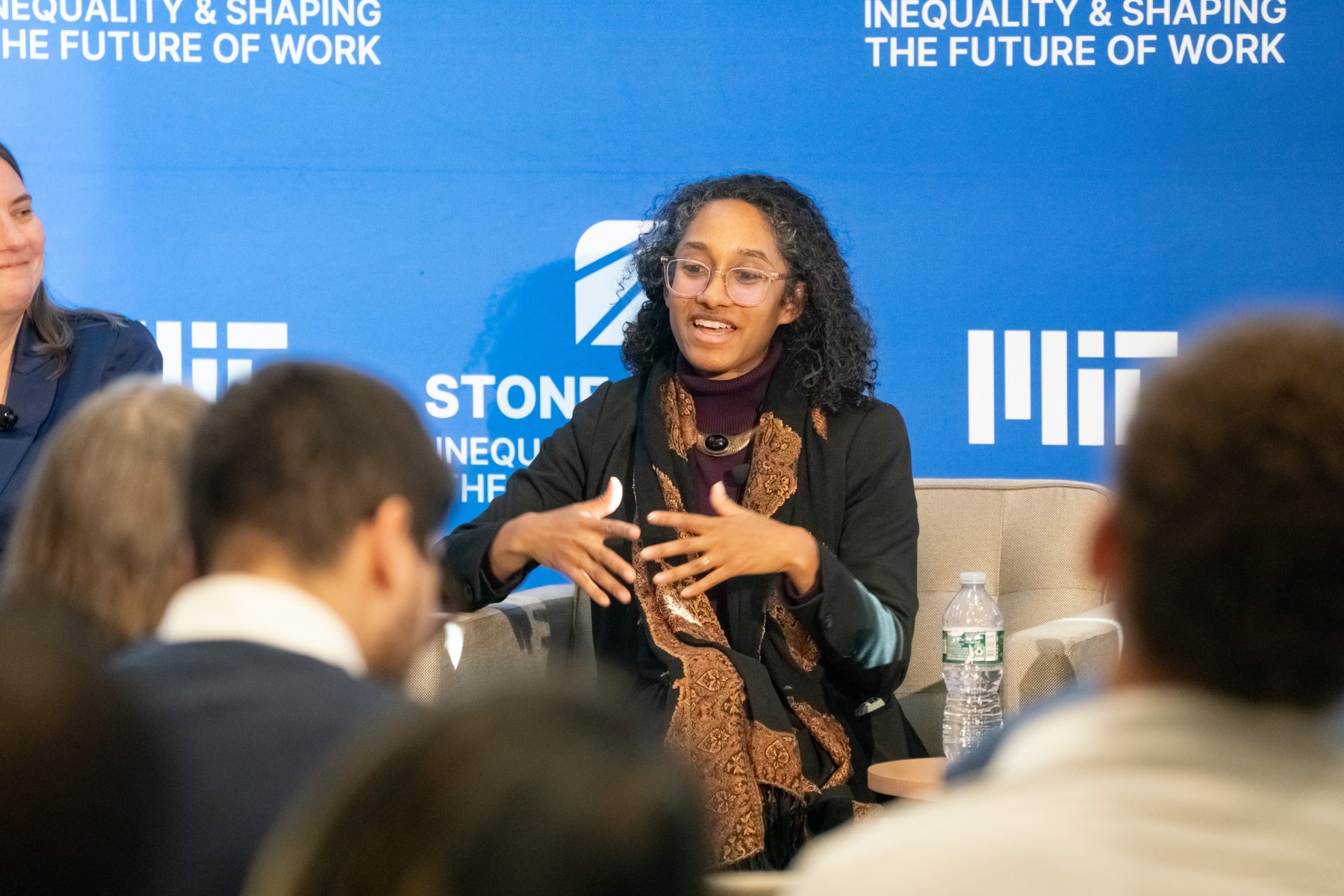
On January 27, 2026, the MIT Stone Center on Inequality and Shaping the Future of Work held a symposium on “Why Wealth Inequality Matters.”
The event’s second panel discussion included Ellora Derenoncourt, Assistant Professor of Economics at Princeton University and the Founding Director of Princeton’s Program for Research on Inequality, Alexandra Killewald, Professor of Sociology and Director of the Stone Center for Inequality Dynamics at the University of Michigan, and Wojciech Kopczuk, Professor of Economics at Columbia University. Their discussion focused on wealth inequality in the US, with Derenoncourt addressing how history has shaped the racial wealth gap.

Photo by Bryce Vickmark.
“A common theme in the panel was measurement. Professor Kopczuk noted that if the inequality we care about is in lifetime spending ability or lifetime income, wealth may not be the metric we want to focus on. Professor Killewald’s work shows that a narrow focus on inheritances, which are substantial only at the top of the wealth distribution, misses the broader importance of parents’ and grandparents’ wealth for an individual’s wealth outcomes, even for poorer households,” shared Derenoncourt after the event.

Photo by Bryce Vickmark.
Derenoncourt’s presentation on racial wealth inequality and its evolution highlighted disparities in wealth between Black and White Americans. “We know from modern survey data that the racial wealth gap in the US, measured as the ratio of per capita White to per capita Black wealth, is about 6 to 1. And it’s been that way for 50 years,” said Derenoncourt during the panel. Derenoncourt reported that she and her collaborators have used historical data to track this wealth gap before and after the Civil War, noting that the largest decline occurred within a few years after emancipation.
“To me, wealth is important because it captures history. The large and persistent wealth gap between Black and White Americans today is equal parts a reflection of wealth gaps at the time of the Civil War and differences in wealth accumulating opportunities during critical periods like Jim Crow. The fact that reparations did not accompany emancipation in the U.S. is a fact we continue to live with today,” said Derenoncourt.
Watch the full panel discussion on YouTube.