Top moments from the first 50 episodes of “The Work Goes On”
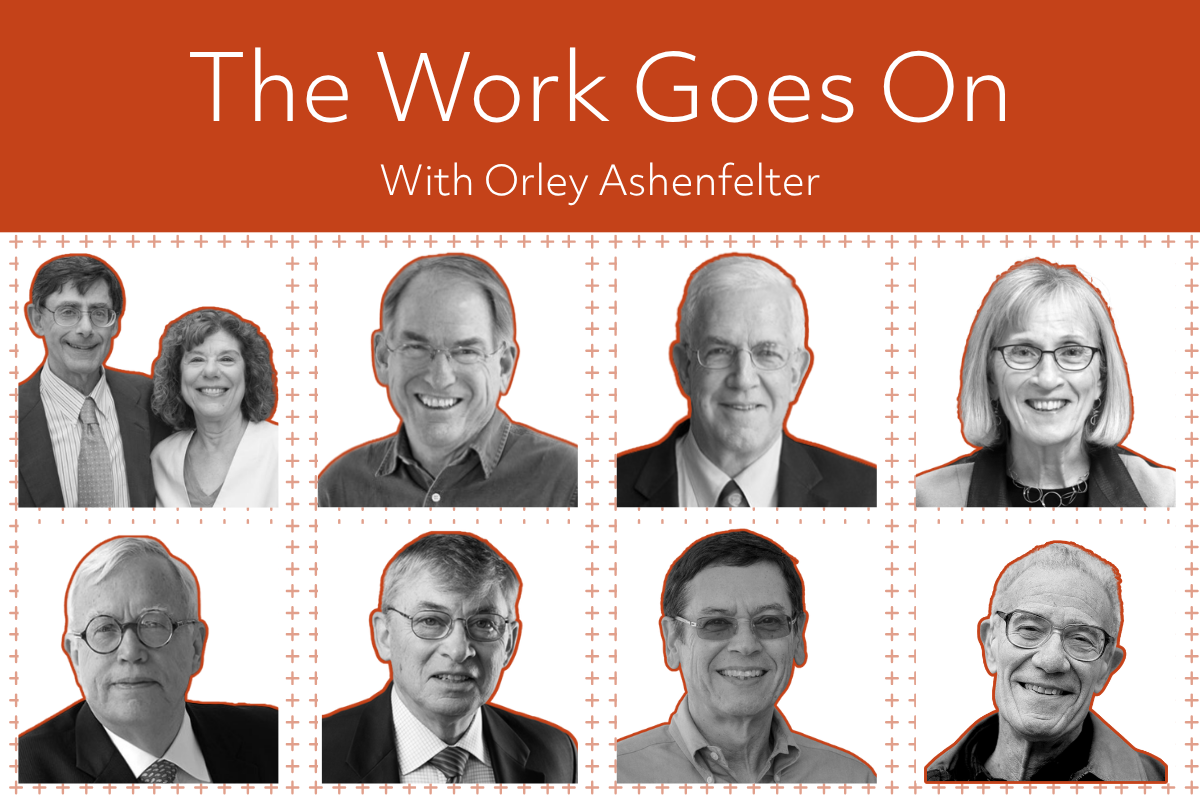
“The Work Goes On” podcast, hosted by Princeton’s Orley Ashenfelter, released its 50th episode on March 16, featuring a conversation with V. Joseph Holtz. To celebrate this milestone, we’ve highlighted several of the podcast’s most impactful moments and fan-favorite episodes below.
Ashenfelter is the Joseph Douglas Green 1895 Professor of Economics emeritus at Princeton University. Over his 50+ years at Princeton, Ashenfelter has been central to shaping the direction of the Industrial Relations Section in the Department of Economics. He is known for his seminal research in labor economics, econometrics, and law and economics.
In 2022, Ashenfelter began “The Work Goes On” podcast, a series of conversations with leading thinkers and practitioners in the field of labor economics, to create “an oral history of an entire generation of industrial relations experts and labor economists whose contributions to their fields have been absolutely extraordinary.”
In each episode, guests, including Bob Solow, Nobel Laureates Claudia Goldin and James Heckman, and many more, talk about their early lives, their mentors, and their biggest professional challenges and achievements.
If you’re a labor economist yourself or are simply interested in learning more about industrial relations, “The Work Goes On” delivers insightful storytelling by the field’s giants.
Francine Blau and Lawrence Kahn: Jobs, research, parenting, and how they do it all together
In Episode 13, Francine Blau and Lawrence Kahn, both professors of economics at Cornell University, join the podcast to discuss what inspired them to study economics, why they enjoy working together, and the current state of gender inequities in the U.S. labor market.
“In the 1990s, the US had one of the highest female labor force participation rates. And in fairly recent work, Larry and I showed that the US progressively lost its position. And now, among economically advanced countries, we have one of the lower rates. And, essentially, our work suggests that work-family policy plays a role in this.”
Samuel Bowles: Transforming economics through the lens of inequality
In Episode 32, Emeritus Professor of Economics at the University of Massachusetts and Research Professor and Director of the Behavioral Sciences Program at the Santa Fe Institute, Samuel Bowles, discusses his deep-rooted interest in economic inequality and how his work has challenged many of the conventional assumptions of modern economic theory.
“It’s certainly not the case any longer that the real big questions of society are being dodged by conventional economics or by the mainstream. Inequality is one of the hottest topics there is, the future of work, climate change. So, I think economics has come to focus more on these serious problems.”
Ronald Ehrenberg: Moving past the fear of failure
Way back in episode two, Ehrenberg joined the podcast to talk with Ashenfelter about the twists and turns that led to his being on the faculty at Cornell–and why industrial relations economists make great university administrators.
“The changes going on in higher education are extraordinary now. Students are thought to be consumers; you have to make consumers happy. You can’t make consumers happy if they are getting low grades.”
Claudia Goldin: A Nobel Prize for an “inner city kid” from the Bronx
In Episode 4, Harvard University’s Claudia Goldin spoke about growing up as an “inner city kid” in the Bronx, how her famous study on the impact of blind auditions at orchestras came to be, and her life’s work studying women’s labor force participation.
“Women’s increase in the labor force is the single most important change in the labor force for almost every country I can think of.”
James Heckman: From Princeton Grad School to a Nobel Prize and beyond
James J. Heckman, Henry Schultz Distinguished Service Professor in Economics at the University of Chicago, joined the podcast in episode 10 to discuss graduate school at Princeton, why an often overlooked paper on the effect of civil rights laws is his favorite, and much more.
“At one point, we were saying, ‘The government couldn’t have done anything,’ but I kept looking at the data. I remember Gale Johnson asking me, ‘Do you really believe the government did good?’ And I said, ‘Yeah, in this case.’ That’s the way I really, honestly believe empirical work should be done in economics, and that’s why, honestly, that’s my proudest paper.”
Thomas Kochan: Mentors, social contracts, and deep dimensions in economics and politics
Thomas Kochan, the George Maverick Bunker Professor Emeritus of Management at the Sloan School of Management at the Massachusetts Institute of Technology, joined the podcast in episode 16 to discuss his life’s work studying unions, arbitrating labor disputes, and advocating for the restoration of a social contract that rewards the contributions of workers.
“… it’s a very rewarding process. It can be frustrating, but when you bring people together and you can see the creative potential of collective bargaining happening right in front of you, that’s when it’s very satisfying.”
Ron Oaxaca: Learning code to modify the Princeton mainframe and develop the Oaxaca Command
In the very first episode of “The Work Goes On,” Ron Oaxaca, the McClellan Professor of Economics Emeritus at the University of Arizona, joined the podcast to speak with Ashenfelter about his research on gender wage gaps and using research to solve real-world problems.
“Certainly, employers now have to pay more attention to their wage structures, even if they feel that they’re not discriminating or don’t have any intentions of discriminating. They have to worry about, ‘how does this appear?'”
Bob Solow: Why I dropped out of Harvard to fight the Nazis
In a wide-ranging interview recorded just months before his passing in December 2023, MIT’s Robert Solow spoke to Ashenfelter about everything from leaving Harvard to fight in WWII to his time serving in President Kennedy’s Council of Economic Advisors.
“I have always felt, I mean, always, my whole life, that whether the economy provides comfort and security and safety for people is as important as anything else.”
To learn more about the IR Section and its over 100 years of impact on research and policy, visit irs100.princeton.edu.