Matias Cattaneo, econometrician and data scientist, joins Princeton Economics faculty
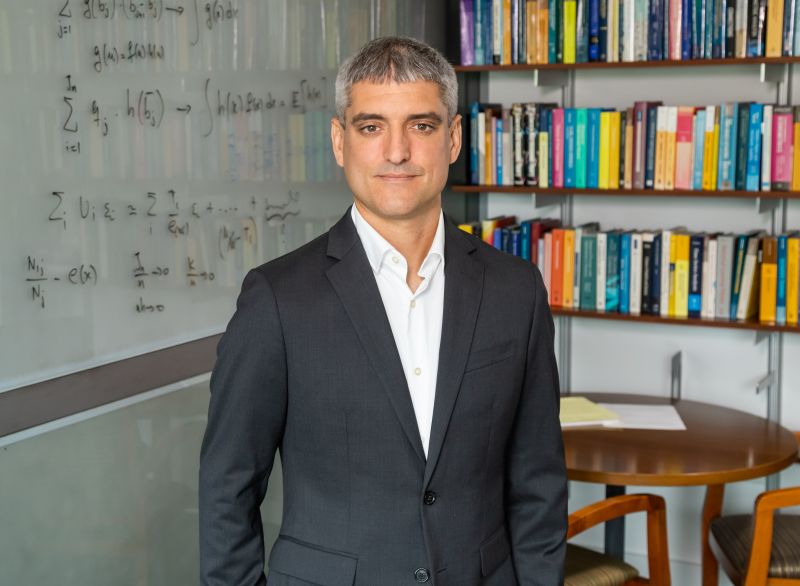
The Economics Department at Princeton is pleased to share that Matias Cattaneo, formerly a faculty member of Princeton’s Department of Operations Research and Financial Engineering, joined the faculty as a Professor of Economics. He is also an affiliated faculty member of the Gregory C. Chow Econometric Research Program and the Julis-Rabinowitz Center for Public Policy and Finance.
Cattaneo’s research focuses on the mathematical and statistical foundations of data science, at the intersection of econometrics, machine learning, and artificial intelligence. He develops statistical and computational methods for the social, behavioral, and biomedical sciences, with emphasis on program evaluation and causal inference. Cattaneo earned a Ph.D. in Economics in 2008 and an M.A. in Statistics in 2005 from the University of California, Berkeley, following his Master in Economics from Universidad Torcuato Di Tella in 2003 and Licentiate in Economics from Universidad de Buenos Aires in 2000. He has held visiting appointments at Harvard, Yale, MIT, and the University of Chicago as well as the Federal Reserve Banks of New York and Philadelphia, and has served as an advisor or consultant for the Inter-American Development Bank and Asian Development Bank. His extensive editorial experience includes roles at Econometrica, Journal of Econometrics, and the Review of Economics and Statistics.
“Working across econometrics, machine learning, and artificial intelligence, I develop theory and methods that help researchers across disciplines draw reliable conclusions from data,” shared Cattaneo. “Much of my work is motivated by questions from economics and the broader social sciences.”
In his published paper, “How Memory in Optimization Algorithms Implicitly Modifies the Loss,” co-authored with his Ph.D. student Boris Shigida, Cattaneo examines how optimization methods used in deep learning lead to exponentially decaying memory and the potential for implicit bias. The paper then introduces a general technique for identifying a memoryless algorithm representation that approximates many optimization algorithms with memory used in practice. The framework helps explain how an algorithm’s use of past training steps can affect the solutions it finds and how well the resulting model performs on new data. For economists and other social scientists who use machine learning, this work helps clarify how training choices can affect the predictions that support their empirical research.
Another area of Cattaneo’s research, microeconomic choice theory, seeks to understand and explain how individuals make decisions with the goal of maximizing their satisfaction given limited time or other resources. In “Attention Overload,” co-authored with Paul H.Y. Cheung, Xinwei Ma, and Yusufcan Masatlioglu, Cattaneo studies buyer choice when alternative products compete for limited attention. The paper introduces an Attention Overload Model, in which alternatives “compete for attention, so each alternative’s consideration probability weakly decreases as the choice problem expands.” This model differs from existing attention models by focusing the analysis on attention frequency while also allowing for heterogeneous preferences.
Together, and with his other recent papers like “Accuracy Limits of Causal Trees for Individualized Treatment Effects” and “On Binscatter,” they illustrate the complementary aspects of Cattaneo’s research: the reliability of causal inference methods, microeconomic choice theory and econometrics, the mathematical foundations of AI training, and rigorous tools for empirical data analysis.
On what he is looking forward to most as an economics faculty member, Cattaneo said, “I’m excited to join Princeton Economics, with its distinguished tradition in econometrics and exceptional intellectual community. I look forward to contributing to that community and collaborating with colleagues and students within the department and across the University.”
“Matias has shaped how empirical economists approach some of the most widely used research designs, from regression discontinuity to binned scatterplots,” shared Ulrich K. Müller, Stanley G. Ivins ’34 and Henrietta Bauer Ivins Professor of Economics and Director of the Gregory C. Chow Econometric Research Program. “His work combines rigorous econometric theory with software that researchers around the world use every day. Cattaneo brings tremendous energy and intellectual generosity. I’m thrilled that he’s formally joining us, where he’ll strengthen the ties between econometrics and statistics across campus.”
Atif Mian, Director of the Julis-Rabinowitz Center for Public Policy and Finance, shared, “We are delighted and honored to have Matias join as a JRCPPF faculty affiliate. His work on the mathematical and statistical foundations of data science and its applications to causal inference and policy evaluation speaks directly to the empirical questions the Center cares most about. We look forward to the contributions he will bring.”