Econometrician Elena Manresa joins Princeton Economics faculty
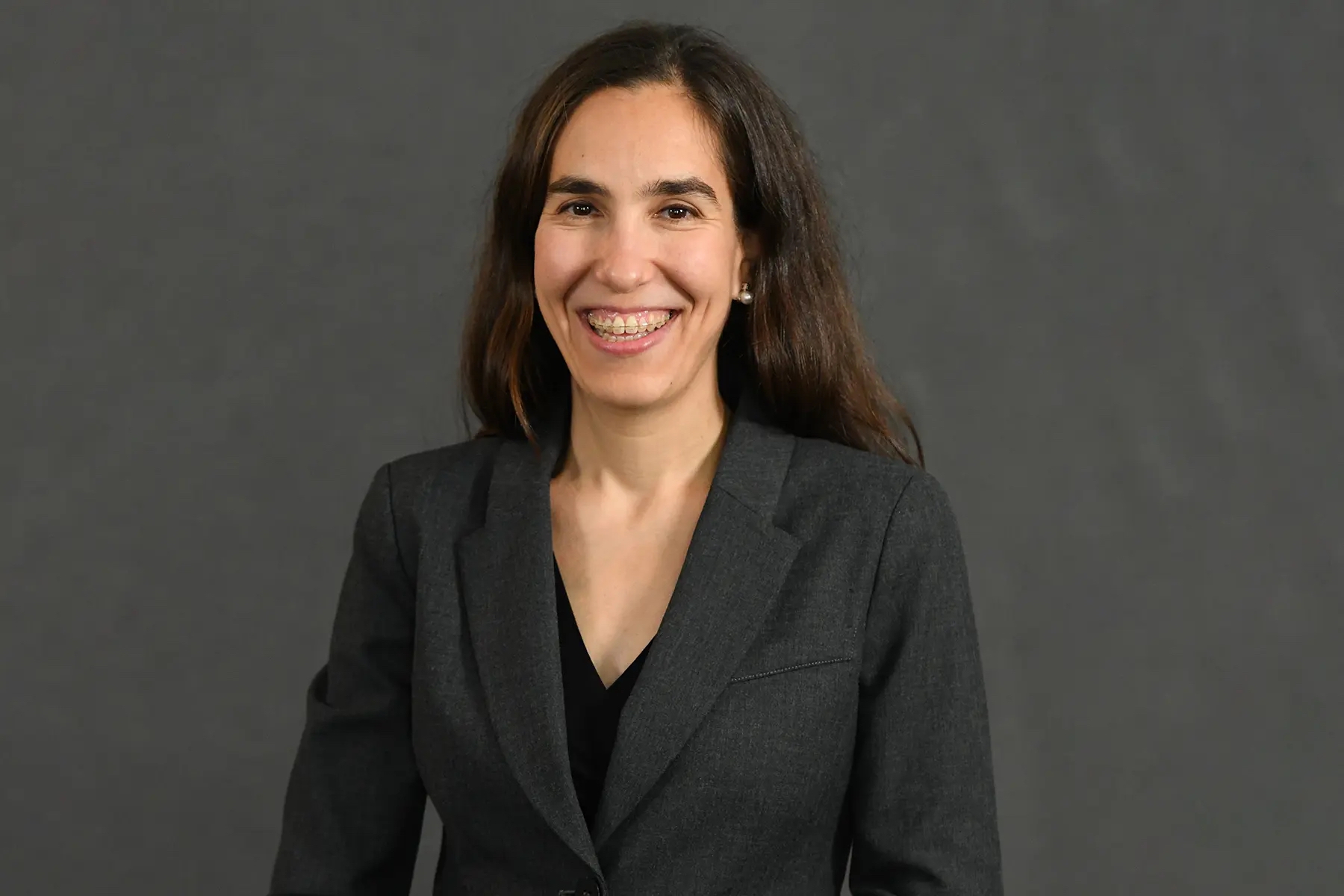
The Economics Department at Princeton is pleased to share that Elena Manresa has joined the faculty as a Professor of Economics. She is also an affiliated faculty member of the Gregory C. Chow Econometric Research Program.
Manresa’s research focuses on econometrics, particularly microeconometrics and financial econometrics, with an emphasis on heterogeneity in economic data. After completing an undergraduate degree in mathematics at the Polytechnic University of Catalonia, she earned her MA in Economics from CEMFI in 2008 and a Ph.D. in Economics in 2014.
“Why do the elderly save? Using health shocks to uncover bequest motives,” a paper published by Manresa and Tetsuya Kaji, uses a framework they (and co-author Guillaume Pouliot) outlined in “An Adversarial Approach to Structural Estimation” to examine the saving behavior of elderly singles. Their method, which adaptively selects the most informative features of the data, reveals that bequest motives explain between 13% and 19% of late-life savings across income levels. “These findings suggest that heterogeneity in health-related survival expectations is another important source of identifying variation for distinguishing bequest and precautionary saving motives.”
In “A Distributional Framework for Matched Employer Employee Data,” a paper published in Econometrica, Manresa and her co-authors, Stéphane Bonhomme and Thibaut Lamadon, aim to identify and estimate earnings distributions and worker composition on matched panel data. By introducing two models—a static model that allows nonlinear interactions between workers and firms, and a dynamic model that also allows Markovian earnings dynamics and endogenous mobility—they establish identification in short panels and develop tractable two-step estimators in which firms are classified in a first step. Additionally, they document that “wages have a direct effect on mobility, and that, beyond their dependence on the current firm, earnings after a job move also depend on the previous employer.”
“Elena’s work on unobserved heterogeneity in panel data, including her influential grouped fixed effects approach, has given applied researchers powerful new ways to uncover structure in their data,” said Ulrich K. Müller, Stanley G. Ivins ’34 and Henrietta Bauer Ivins Professor of Economics and Director of the Gregory C. Chow Econometric Research Program. “She moves easily between econometric methodology and substantive economic questions, which makes her a natural collaborator for colleagues across the department. I’m also confident that she will be a wonderful mentor to our students. Elena’s arrival makes the econometrics group an even more vibrant place.”
Reflecting on what she is looking forward to most in this next chapter at Princeton, Elena shared, “I’m very excited to join the Department of Economics and become part of such a stimulating academic community. I’m grateful for the opportunity to contribute to the department, and I look forward to learning from my new colleagues. I’m especially excited about the conversations, research, and new ideas that lie ahead.”